Guide
Shawarma street food culture: how to order, eat and judge a good shop
What the queue, the knife and the sauce station tell you about a shawarma shop, and how to order like a regular anywhere from Beirut to Berlin.
Read the spit before you order
A good stack is tightly packed with no visible gaps, glossy rather than dry, and noticeably darker on the outside than the inside. Gaps mean the meat was loaded carelessly and will cook unevenly. A pale, sweating stack means it has been reheated rather than cooked through the service. A blackened crust with no shaving marks means it has been sitting.
Watch the knife
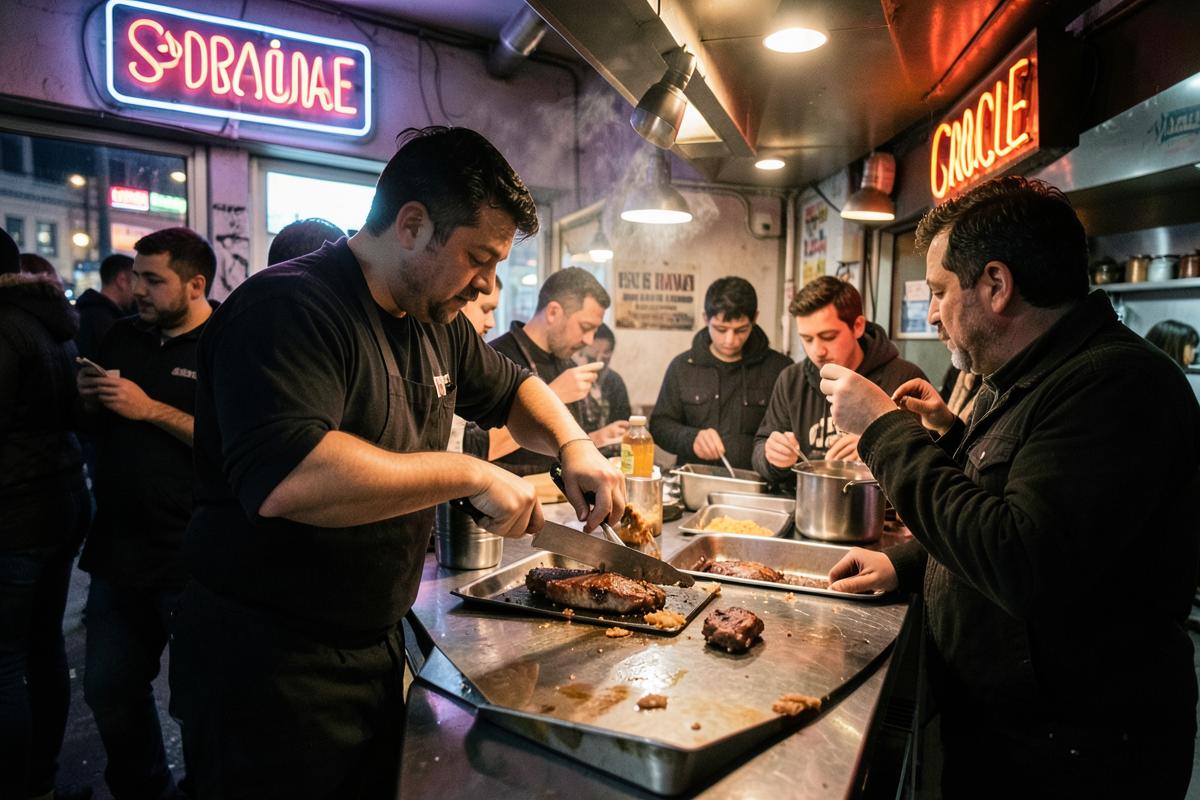
The cook should shave in long downward strokes, taking thin ribbons that fall in a curl. Chunks mean a blunt blade or a rushed hand, and chunks eat dry. In many shops the best moment is the first shave after a rest, when the outermost layer is at its crispest.
The sauce station tells you everything
A shop that makes its own toum will have a bowl of it that is bright white, stiff enough to hold a peak, and unmistakably sharp. Thin, greyish garlic mayonnaise from a tub is a different product. The same goes for pickles: house-made pink turnips and cucumbers signal a kitchen, not just a counter.
How to order in the Levant
In Beirut you order by protein and let the shop decide the rest: chicken with toum and pickles, beef with tahini and tomato. Asking for both sauces on one wrap marks you as a visitor. Sandwiches are wrapped tight and pressed on a hot plate, and they are meant to be eaten immediately, standing up.
How to order in Turkey
Ask for durum if you want a rolled lavash wrap, ekmek arasi for it in bread, or porsiyon for a plate with rice and salad. Iskender, doner over pide with tomato sauce and browned butter, is a sit-down meal rather than street food. Ayran, salted yogurt drink, is the standard accompaniment and is a genuinely better match than a soft drink.
How to order in Europe
In Germany a doner comes with a choice of sauce and salad and you will be asked scharf or nicht scharf, hot or not. In much of the UK the equivalent question is chilli sauce and garlic sauce, often both. Ordering everything is normal and nobody will judge you.
The etiquette of eating it
Shawarma is street food and is built to be eaten in the hand within minutes of being wrapped. It does not travel and it does not reheat well: the bread goes leathery and the meat dries. If you are taking it home, ask for the sauce on the side and press the wrap yourself in a dry pan.
Late night, everywhere
Across the Middle East, Europe and increasingly North America, the shawarma shop is the last thing open. That role shaped the food: fast, hot, filling, cheap, and forgiving of a hungry crowd. It is also why a shop at 2am tells you more about its standards than one at 2pm.
Judging a shop in one bite
The test is contrast. Crisp shaved edges against soft interior meat, sharp pickle against rich fat, warm bread that has been pressed rather than steamed. If everything in the wrap tastes the same temperature and the same texture, the shop is cutting corners somewhere.