Guide
Food safety and temperatures for shawarma at home
Stacked, slow-turning meat sits in the temperature danger zone longer than most cooking. Here are the marinating, cooking, holding and reheating rules that keep it safe without ruining the texture.
Why shawarma needs extra care
A vertical stack cooks from the outside in, slowly, and the interior can sit between 5°C and 60°C — the range where bacteria multiply fastest — for a considerable time. Commercial operations manage this with strict rules and temperature logs. At home you manage it with three habits: marinate cold, cook the whole stack through before serving from the centre, and never hold cooked meat lukewarm.
Marinating safely
Always marinate in the refrigerator at or below 4°C, never on the counter, and never for the thirty minutes people assume is fine on a warm day. Use a non-reactive container — glass, ceramic or food-grade plastic, not bare aluminium or copper, which react with acid. Keep the container on the bottom shelf so nothing can drip onto ready-to-eat food below.
Never reuse raw marinade
Marinade that has held raw meat contains everything the meat's surface carried. If you want to use it as a sauce or a baste, bring it to a rolling boil for at least three minutes first. Otherwise throw it away. Do not brush raw marinade onto meat during the last minutes of cooking; there is not enough time or heat at the surface to make it safe.
Target internal temperatures
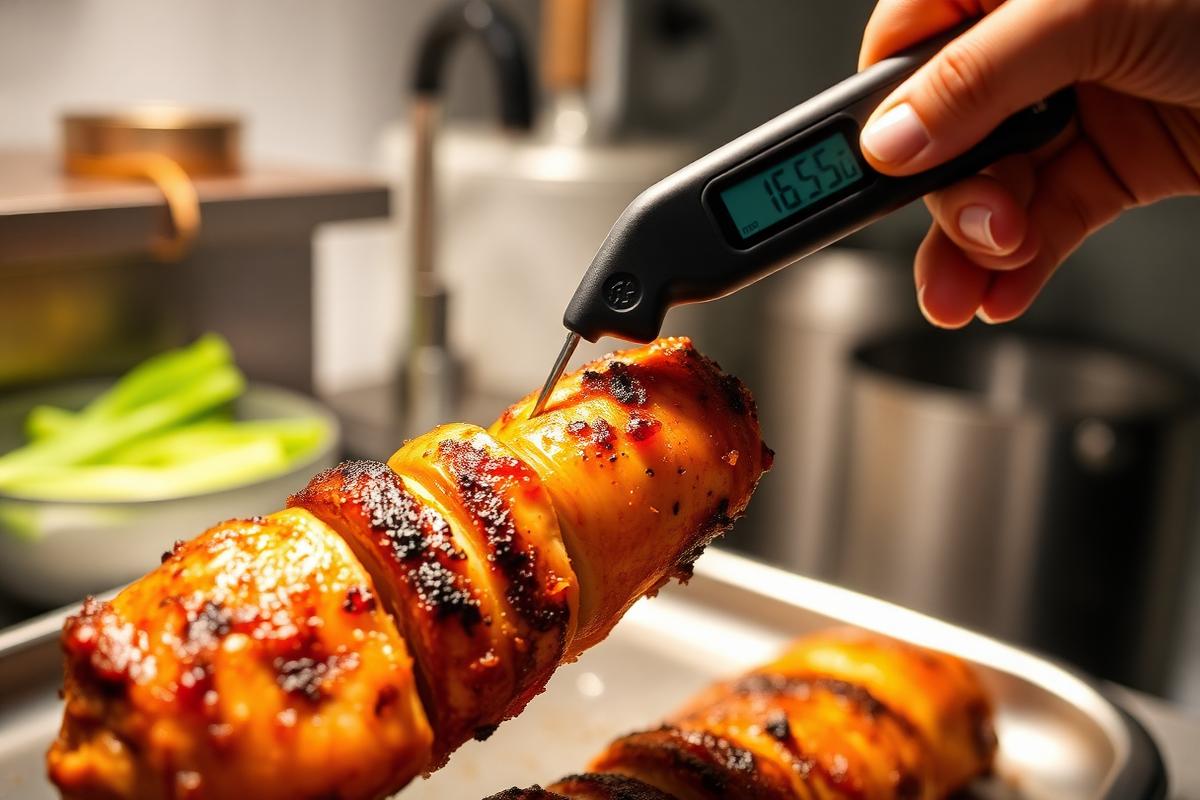
Chicken and all poultry: 74°C throughout. Ground or minced meat, including kafta: 71°C. Whole cuts of beef and lamb: 63°C for medium, with a three-minute rest. Slow-cooked lamb shoulder goes far past this to 92-95°C, which is a texture target rather than a safety one. Measure in the thickest part, away from bone and away from the spit, and take two readings in different spots on a stack.
Use a real thermometer
Colour is not a doneness test. Chicken can stay pink at 80°C because of myoglobin binding, and beef can turn grey well below a safe temperature. An instant-read digital thermometer costs less than one takeaway order and is the only reliable tool. Check its accuracy occasionally in ice water — it should read 0°C within a degree.
Cross-contamination discipline
Keep one board and one knife for raw meat and a completely separate set for cooked meat and vegetables. Your long slicing knife must never touch the raw stack. Wash hands, boards and utensils with hot soapy water immediately after handling raw meat, and change the cloth you wipe surfaces with — a used cloth spreads more than it cleans.
Holding cooked meat
Serve shaved meat straight away. If you must hold it, keep it above 60°C in a covered dish in a low oven, not on a warm hob or under a heat lamp that only warms the top layer. The two-hour rule applies: cooked meat that has been between 5°C and 60°C for more than two hours should be discarded, and in a hot kitchen that window drops to one hour.
Cooling and storing leftovers
Cool leftovers fast — spread the meat on a wide tray rather than leaving it in a deep bowl, and get it into the fridge within an hour of serving. Store in shallow airtight containers for up to three days, or freeze in portions for up to three months. Label with the date, because cooked shawarma looks the same on day one and day five.
Reheating
Reheat once only, and take it to 74°C throughout. A dry hot pan for two or three minutes gives the best texture and re-crisps the edges. The oven at 200°C works for larger amounts. Microwaving is safe if you stir halfway and check the temperature, but it steams the meat and softens everything you worked to crisp. Never reheat rice more than once, and cool it fast the first time.