Guide
The history of shawarma: from Ottoman kitchens to the whole world
How a horizontal Anatolian kebab was turned on its end in the nineteenth century and became the most travelled street food on earth.
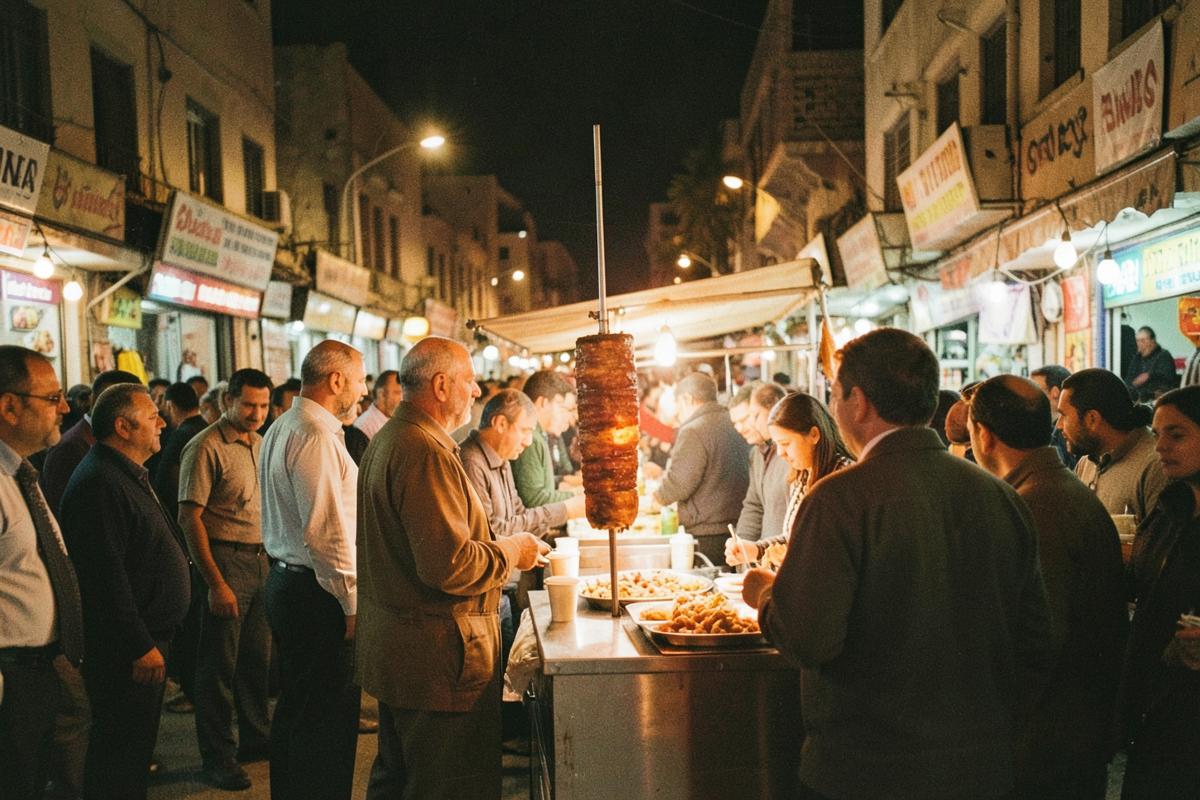
A word that means turning
Shawarma comes from the Turkish cevirme, meaning to turn or rotate. That single word carries the entire technique. Everything that distinguishes shawarma from other grilled meat comes from the fact that the stack rotates past a fixed heat source rather than sitting over it, so the surface cooks and is shaved away while the interior waits its turn.
Before the spit stood up
For centuries kebab in Anatolia and the Levant was cooked horizontally over coals. Meat was threaded on skewers and laid across a trench of embers. It worked, but fat dripped into the fire, flared, and coated the meat in soot. Cooks accepted that as the cost of grilling.
The nineteenth century turn
By the middle of the nineteenth century cooks in Bursa, in northwest Turkey, had stood the skewer upright and moved the fire to the side. The change solved the dripping problem at a stroke: rendered fat now ran down the stack, basting the layers beneath it instead of burning. The technique spread quickly because it also solved a commercial problem. A vertical stack holds far more meat than a skewer, cooks continuously through a service, and lets a single cook serve a queue without ever waiting for a new batch.
Travelling south into the Levant
The method moved south with trade and with people. In Lebanon, Syria and Palestine cooks kept the vertical spit but rebuilt the flavour around their own pantry: allspice, cinnamon, cardamom, cloves and a sharp vinegar or lemon marinade rather than the milk and oregano of Anatolia. Chicken shawarma with toum, the whipped garlic emulsion, is a Levantine invention and remains its most recognisable form.
Crossing the Mediterranean
Greek cooks adopted the same spit and called the result gyro, from the Greek for turn, most commonly built from pork and dressed with tzatziki. In Mexico, Lebanese immigrants who arrived in Puebla in the early twentieth century brought their spits with them. Local cooks swapped lamb for pork, added achiote and dried chillies, served it on a corn tortilla with pineapple, and created tacos al pastor: the same machine, a completely different dish.
The post-war European boom
Doner as most Europeans know it, served in bread as a full meal with salad and sauce, was popularised in Berlin in the early 1970s by Turkish workers who adapted the plated Istanbul dish into something a customer could eat while walking. That format, meat plus salad plus sauce in bread, is now the default across Europe and has been re-exported back to Turkey.
Why it spread so far
Shawarma travelled because it is efficient before it is exotic. It uses cheaper cuts, wastes almost nothing, holds at temperature for hours, and scales to a queue. Those are the same qualities that made it useful in a Bursa kebab house and in a Berlin snack bar a century later.
What this means at home
Almost every home method, whether a rotisserie attachment, a loaf tin stack or a hot pan, is an attempt to recreate two things the vertical spit does automatically: continuous self-basting and a surface that is always drier and hotter than the interior. Judge your setup by whether it delivers those two effects, not by whether it looks like a shop spit.