Guide
Bread, pickles and the perfect wrap
The assembly stage is where most home shawarma falls apart — literally. Here is how to choose your bread, balance the fillings, roll it tight and toast it so it holds together to the last bite.
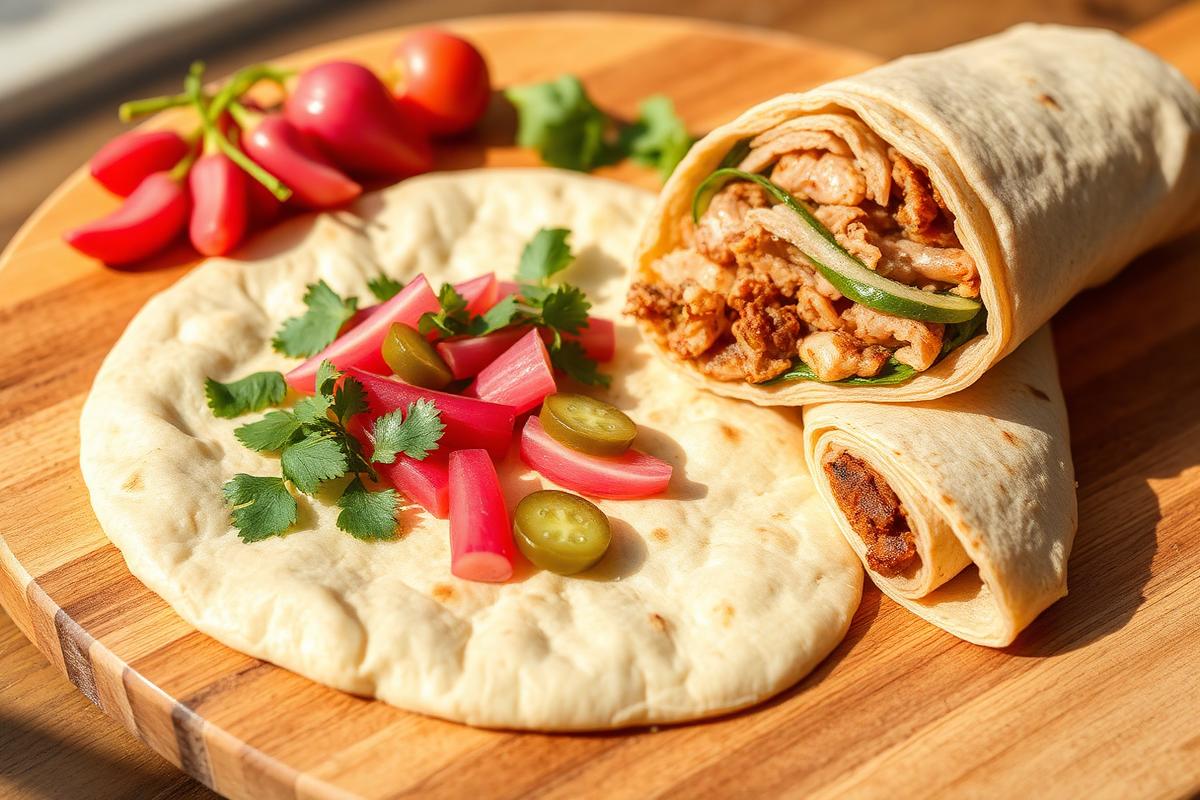
The wrap is a construction problem
A shawarma is not a sandwich you fill, it is a structure you build. Every element has a role: bread as the shell, sauce as the waterproof layer, meat as the mass, pickles as the acid, and herbs as the aroma. Get the order wrong and the bread goes soggy in three minutes and splits at the fold. Get it right and the wrap holds its shape from the first bite to the last, staying hot the whole way through.
Choosing bread
Lebanese markouk — the very thin, wide saj bread — is the traditional choice and rolls tightest. Standard pocketless pita is the easiest to buy and works well. Pocket pita can be split and stuffed instead of rolled, which is a different and equally good sandwich. Avoid thick, fluffy Greek-style pita for rolling: it cracks along the fold. Whatever you use, it must be warm and pliable; cold bread tears every time.
Warming the bread properly
Thirty seconds per side on a dry hot pan, or ten seconds directly over a gas flame, or a stack wrapped in foil for five minutes in a 180°C oven. Do not microwave it uncovered — it turns leathery within a minute of coming out. If your bread is dry, flick a few drops of water onto the pan as it heats and let the steam soften it.
Layer order
Sauce first, directly onto the bread, in a stripe down the centre-third rather than spread edge to edge. The fat in toum and tahini forms a barrier that stops meat juices soaking into the bread. Then the hot meat down the middle. Then pickles and any wet vegetables on top of the meat, never underneath it. Herbs last. Leave a clear 4 cm border at the bottom and along one side.
Don't overfill
The single most common mistake. A wrap should be about 150-180 g of meat for a standard pita — roughly what fits in a loose fist. Overfilled wraps cannot be rolled tightly, and a loose roll unravels the moment it is picked up. If you want more food, make two wraps rather than one fat one.
The roll
Fold the bottom edge up over the filling first to close the base. Then fold one side over the filling and pull it back towards you, using the edge of the bread to compact the filling into a tight cylinder — this tension step is what professional rollers do and home cooks skip. Continue rolling to seal, finishing seam-side down.
The toast
Press the rolled wrap seam-side down on a hot dry pan or in a sandwich press for 60 to 90 seconds per side. The bread crisps, the seam fuses shut, and the whole wrap firms up into something you can hold in one hand. This step also reheats the outside of the wrap, which matters if you built several in a row.
Pickles and the acid balance
Rich, fatty meat needs sharp acid opposite it. Pink pickled turnips are traditional, cucumber pickles are the everyday alternative, and pickled chillies add heat and acid together. Two or three batons per wrap is enough — more and the pickle brine waterlogs the bread. A squeeze of lemon over the meat before rolling does a similar job when you have no pickles.
Wrapping for travel
If the wrap is not being eaten immediately, roll it in a sheet of greaseproof paper, twisting the ends, before it goes anywhere. The paper absorbs surface moisture and keeps the roll compressed. Foil traps steam and softens the crust, so use it only if you want the wrap to stay hot rather than crisp.